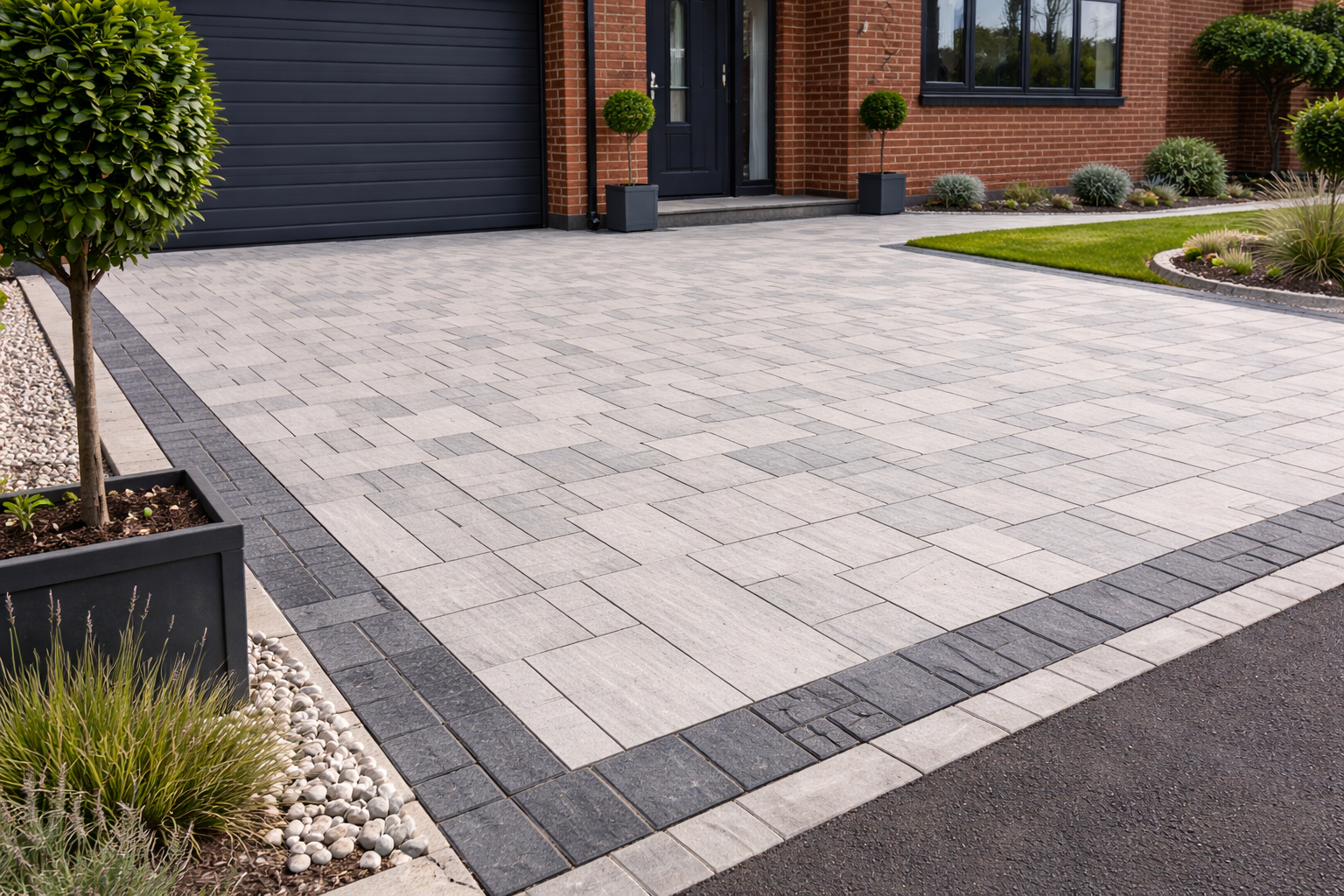
The Hidden Costs of Poor Driveway Design

Many homeowners see a driveway as a simple surface. If it looks neat and supports a vehicle, it feels fit for purpose. In reality, poor driveway design is one of the most expensive mistakes a homeowner can make. The problems rarely appear straight away. Instead, they emerge gradually through structural failure, ongoing repairs, drainage issues and reduced property value.

A driveway is not just a finished surface. It is a layered system that must manage weight, water, weather and access every day. When these fundamentals are overlooked, the costs become unavoidable.

1. Drainage Problems

Inadequate drainage is one of the most common and damaging consequences of poor driveway design. When water is not directed away correctly, it sits on the surface or runs toward the property. Over time, moisture penetrates joints and weakens the sub-base beneath.

During colder months, trapped water expands and contracts, causing cracks and surface movement. In more severe cases, poor drainage can contribute to damp issues near foundations or thresholds. Rectifying drainage after installation often requires lifting sections of the driveway, making it far more expensive than addressing the issue during the design stage.

2. Weak Foundations

The performance of a driveway depends almost entirely on what lies beneath it. Poor excavation depth, incorrect sub-base materials, or insufficient compaction all lead to structural weakness.

At first, the driveway may appear stable. As vehicles use the surface repeatedly, weight exposes these flaws. The result is sinking, rutting and cracking, particularly in high-stress areas such as turning points or wheel tracks. These failures are not cosmetic. They usually require full reconstruction rather than simple repairs, adding significant long-term cost.

3. Incorrect Levels

Driveway levels must be carefully calculated to ensure safe access and effective water management. Poor driveway design often results in surfaces that slope the wrong way, create trip hazards or allow water to flow toward the house.

Even small level errors can cause daily inconvenience. Doors may catch, steps feel awkward and transitions become uncomfortable. Over time, these issues affect usability and safety. Correcting levels after installation almost always involves removing and rebuilding the surface, increasing disruption and expense.

4. Material Misuse

Selecting materials based on price rather than suitability leads to long-term maintenance issues. Some driveway surfaces look appealing when new but perform poorly under regular vehicle use or in local weather conditions.

Low-quality block paving may fade, shift or become uneven. Poorly specified tarmac can soften, crack or stain. Inappropriate gravel installations often migrate and require constant topping up. These ongoing issues increase maintenance costs and reduce the lifespan of the driveway.

5. Visual Impact

A driveway plays a major role in kerb appeal. Poor design choices, visible deterioration or awkward layouts can undermine the appearance of an otherwise well-maintained property.

Potential buyers often notice the driveway first. Cracks, standing water and uneven surfaces suggest neglect and future expense. This can negatively affect property value and buyer confidence. A well-designed driveway, by contrast, enhances first impressions and supports long-term value.

6. Compliance Issues

Another hidden cost comes from ignoring planning and drainage regulations. Poor driveway design may fail to account for permeable surface requirements or correct water management.

Non-compliant driveways can result in enforcement action or the need for costly alterations. Retrofitting compliance measures is almost always more expensive than designing correctly from the outset.

7. Long-Term Costs

Good driveway design considers structure, drainage, materials and access from the beginning. It anticipates how the surface will perform over many years, not just how it looks on completion day.

A properly designed driveway requires less maintenance, performs reliably in all weather conditions and lasts significantly longer. While the initial investment may be higher, the long-term cost is considerably lower.

Final Thoughts

The true cost of a driveway is not the installation price alone. It is the cost of repairs, maintenance, inconvenience and lost value over time. Poor driveway design hides these costs until they become unavoidable.

Investing in proper design from the start protects your home, your finances and your peace of mind. A driveway built on sound principles will continue to perform long after cheaper alternatives have failed.

7 Small Garden Design Ideas that Feel Spacious and Luxurious

One of the biggest misconceptions homeowners have is that a small garden limits what’s possible. In reality, some of the most elegant and luxurious gardens are compact. The difference lies not in size, but in design quality. Poorly planned small gardens often feel cramped, cluttered, and impractical, while professionally designed spaces can feel calm, expansive, and refined.

At Harris Garden Design, we regularly work with compact outdoor spaces and see first-hand how thoughtful design transforms them. With the right layout, materials, and planting strategy, a small garden can feel like a seamless extension of the home rather than an afterthought.

1. Designing for perception

Luxury in small garden design is about perception. The way a space feels is far more important than its actual measurements. When a garden is overcrowded with features or poorly organised, the eye stops short, making the space feel tight and uncomfortable. By contrast, a well-composed garden encourages the eye to travel naturally, creating a sense of openness.

A key principle is restraint. Rather than trying to fit everything into a limited footprint, successful small garden design focuses on clarity and purpose. Each element should earn its place. Open space is not wasted space; it is what allows the garden to breathe and feel balanced.

2. Simplifying the layout

In small gardens, complex layouts work against you. Multiple zones, competing shapes, and unnecessary changes in level often make a garden feel broken up and smaller than it really is. A more luxurious approach is to simplify the layout and allow one clear design language to dominate.

A single, well-defined area that can be used flexibly for dining, relaxing, or entertaining often works better than several cramped zones. Clean lines, consistent geometry, and uninterrupted surfaces help maintain visual flow. When the layout feels calm and intentional, the garden immediately appears larger and more refined.

3. Choosing materials that elevate the space

Material choice plays a major role in how spacious a small garden feels. Too many different finishes create visual clutter, which reduces the sense of scale. Limiting the palette to two or three complementary materials creates cohesion and a high-end look.

Large-format paving is particularly effective in compact spaces. Fewer joints mean fewer visual interruptions, allowing the surface to read as one continuous plane. Porcelain and natural stone are popular choices for this reason, offering durability as well as a clean, contemporary aesthetic.

Consistency is key. Repeating the same material across steps, seating, or edging reinforces the design and avoids the fragmented look that often makes small gardens feel busy.

4. Using planting to add structure and depth

Planting is often where small gardens go wrong. Overloading the space with too many plant varieties creates visual noise and makes the garden feel crowded. A more luxurious approach focuses on structure first and decoration second.

Using a limited selection of plants, repeated throughout the garden, creates rhythm and cohesion. Structural planting such as evergreen shrubs, pleached trees, or ornamental grasses provides year-round form and anchors the design. Softer planting can then be layered in to add seasonal interest without overwhelming the space.

Vertical planting is especially valuable in small gardens. Drawing the eye upward through climbers, trained trees, or tall planting beds adds depth and makes the garden feel taller and more expansive.

5. Creating the illusion of depth

Depth is one of the most powerful tools in small garden design. Even in a short garden, careful layering can create the impression of distance. This is achieved by arranging elements in a visual sequence, with lower planting or open space in the foreground, medium-height features in the middle, and taller planting or structures at the boundary.

Boundaries should be treated with care. Busy fences or multiple finishes draw attention to the garden’s limits. A single, consistent boundary treatment, softened with planting, allows the edges to recede visually. Darker tones are particularly effective, as they make boundaries less prominent and enhance the sense of space.

6. Selecting furniture and features with intention

In compact gardens, furniture and features must be chosen carefully. Oversized or poorly proportioned items quickly dominate the space and disrupt balance. Built-in elements such as seating or planters often work better than freestanding furniture, as they feel bespoke and reduce clutter.

Luxury is achieved through intention rather than quantity. One well-chosen feature, such as a subtle water element or a statement planting area, creates focus without overwhelming the garden. Everything else should support this focal point, not compete with it.

7. The role of lighting in small garden luxury

Lighting has a transformative effect on small gardens, yet it is frequently overlooked. Thoughtful lighting design extends the usability of the space into the evening and adds depth after dark. Low-level lighting, gentle uplighting, and concealed light sources create atmosphere without harsh glare.

By highlighting vertical elements and textures, lighting reinforces the illusion of space and enhances the garden’s overall sense of luxury. The aim is subtlety rather than brightness, allowing the garden to feel inviting and sophisticated.

Luxury Is a Design Choice

A small garden does not need to feel restrictive. With the right design approach, it can feel spacious, elegant, and genuinely luxurious. The key lies in simplicity, proportion, and thoughtful detailing. Every decision, from layout to planting to materials, should serve a clear purpose.

When designed properly, a compact garden can offer more impact and enjoyment than a larger, poorly planned space. Luxury is not about how much you include, but how well each element is considered and executed.

Ready to Transform Your Small Garden?

A small garden has the potential to be one of the most beautiful and valuable spaces in your home — when it’s designed properly.

If your garden feels cramped, underused, or disconnected from your home, a professionally designed solution can change how you experience your outdoor space every day.

At Harris Garden Design, we specialise in creating bespoke garden designs that maximise space, enhance flow, and deliver a refined, luxurious finish — even in the most compact gardens.

Book a design consultation today and discover how your small garden can feel spacious, elegant, and effortless to maintain.

👉 Get in touch to start your garden transformation.

A Refined Porcelain Patio and Lawn Garden for a Terraced Home in Bolton

Small terraced gardens are often underestimated. Many homeowners assume that limited space means limited potential, and as a result, these gardens are frequently left underdeveloped or treated as an afterthought. In reality, compact outdoor spaces demand a higher level of design discipline than larger gardens. Every decision has a visible impact, and poor choices are far harder to disguise.

This Bolton terraced garden project is a clear example of how thoughtful planning, precise workmanship, and restrained material selection can transform a modest space into a calm, functional, and visually balanced garden that works effortlessly with the home.

Why Simple Design Works Best in Small Gardens

In small garden design, simplicity is not a compromise. It is a strategic decision. Overcomplicating a compact space with too many materials, features, or planting styles often leads to visual clutter and practical frustration.

Harris Garden Design and Landscaping approached this project by stripping the layout back to its essentials. The goal was to create clarity rather than complexity, allowing each element to perform its role effectively.

A strong, simple layout provides the foundation for a garden that feels organised and easy to use. In this case, that meant clearly defining the patio area closest to the house, establishing a crisp lawn shape, and ensuring the transition between surfaces was clean and durable.

The Role of Porcelain Paving in Terraced Gardens

Porcelain paving was selected as the primary hard landscaping material for this project, and for good reason. In Bolton’s climate, surfaces must cope with regular rainfall, temperature changes, and year-round use. Porcelain offers excellent slip resistance, low water absorption, and minimal maintenance, making it particularly well suited to terraced gardens.

The large-format paving slabs help reduce visual noise by limiting joint lines, which is especially important in smaller spaces. Fewer interruptions across the surface allow the eye to travel more freely, making the garden feel larger and more open.

Careful setting out ensured the paving aligned neatly with the house and garden boundaries. This level of precision is critical in compact gardens, where even small inaccuracies can disrupt the overall balance of the space.

Creating Definition Without Closing the Space In

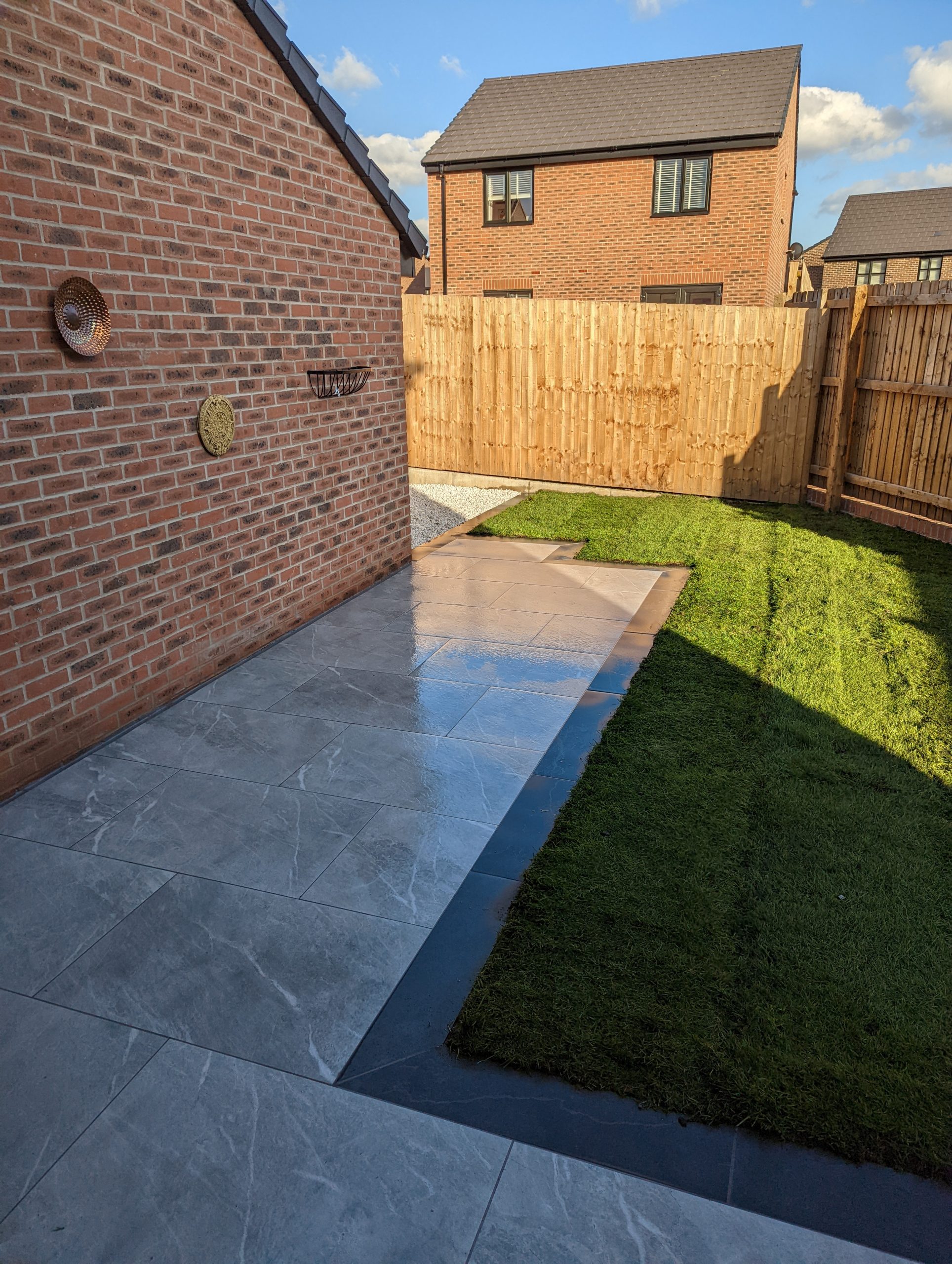
One of the most effective features of this garden is the use of a contrasting border between the porcelain paving and the lawn. This detail may appear subtle, but it plays an important role in defining zones and guiding movement through the garden.

The darker edging frames both surfaces, providing visual structure while also serving a practical purpose. It prevents movement between materials, protects the lawn edges, and maintains crisp lines over time. In small gardens, these details help reinforce a sense of order and permanence.

Rather than relying on raised features or additional structures, the design uses surface definition to achieve separation. This keeps the garden open and uncluttered while still feeling intentional.

A Lawn That Feels Considered, Not Leftover

Lawns in terraced gardens are often treated as leftover space rather than a deliberate design element. In this project, the lawn was reshaped and positioned with purpose.

By keeping the lawn form simple and geometric, it complements the clean lines of the paving rather than competing with it. The clear rectangular shape reinforces the structured layout of the garden and provides a soft contrast to the hard surfaces without overwhelming the space.

The lawn also improves usability. It offers visual relief, seasonal colour, and a practical surface that can be enjoyed without increasing maintenance demands.

Attention to Levels, Drainage, and Detail

Although the garden appears simple on the surface, achieving this level of refinement requires careful technical planning. Levels were adjusted subtly to ensure effective drainage away from the house, while maintaining a smooth, comfortable transition between areas.

Every cut, joint, and edge was executed with precision. In compact gardens, workmanship becomes far more visible, and Harris Garden Design and Landscaping places strong emphasis on these details. Clean finishes ensure the garden not only looks good on completion, but continues to perform and age well over time.

Why This Garden Works So Well

This project succeeds because it respects the scale of the space and the needs of the homeowners. It does not attempt to introduce unnecessary features or follow short-lived trends. Instead, it focuses on proportion, clarity, and durability.

The result is a garden that feels calm, practical, and easy to live with. It works equally well for everyday use and occasional entertaining, and it complements the architecture of the terraced home rather than competing with it.

This approach reflects Harris Garden Design and Landscaping’s belief that successful garden design is not about doing more, but about doing the right things well.

A Thoughtful Approach to Terraced Garden Design

Terraced gardens present unique challenges, but they also offer opportunities for refined, disciplined design. When materials are chosen carefully, layouts are simplified, and details are executed precisely, even modest spaces can feel generous and well resolved.

This Bolton project demonstrates how a considered approach can elevate a straightforward garden into a space that feels intentional, balanced, and built to last.

Considering a Garden Upgrade for Your Terraced Home?

If you are looking to improve a terraced garden and want a space that feels practical, low maintenance, and thoughtfully designed, professional input makes a significant difference.

Harris Garden Design and Landscaping specialises in creating well-crafted gardens that respond to real homes, real spaces, and real lifestyles.

Get in touch to discuss how your garden could be transformed with clarity, precision, and care.

Small Garden Design Ideas for Terraced Homes in Bolton

Many homeowners living in terraced properties across Bolton believe that a small garden automatically limits what is possible. The most common misconception is that compact outdoor spaces must remain basic, cluttered, or purely functional. Lawns become patchy, patios feel cramped, and planting often looks forced rather than intentional. In reality, small garden design is not about compromise. It is about precision, planning, and understanding how to make every square metre work harder.

Terraced homes present unique challenges, but they also offer unique opportunities. When designed properly, a small terraced garden can feel calm, generous, and beautifully connected to the home. The key lies in understanding scale, flow, planting, and structure, and in avoiding the mistakes that so often undermine compact spaces.

Understanding the challenges

Terraced gardens in Bolton tend to share several defining characteristics. They are often long and narrow, enclosed by neighbouring fences or walls, and overlooked from multiple angles. Light levels can vary significantly, with shade at the rear and stronger sun closer to the house. Drainage can also be inconsistent, particularly in older properties with heavy clay soils.

Many design problems arise when these realities are ignored. Oversised features dominate the space, planting becomes overcrowded, and circulation feels awkward. Good small garden design starts with acknowledging the limitations of the space and using them to guide smarter decisions rather than fighting against them.

Bolton’s climate also plays a role. Frequent rainfall, cooler temperatures, and seasonal shifts mean materials, planting, and layout choices must prioritise durability and year-round usability. A garden that looks good in summer but feels unusable for the rest of the year is rarely a success.

Start with structure

Before choosing plants or finishes, begin with creating a layout. Structure defines how the space is used and how it feels when viewed from the house.

In narrow gardens, a common mistake is placing everything along the edges. This creates a corridor effect that exaggerates the length and highlights the lack of width. Instead, breaking the space into subtle zones can dramatically improve balance.

A small garden might include a seating area near the house, a secondary space further down the garden, and a simple focal point at the end. These zones do not need to be physically separated. Changes in surface material, level, or planting density are often enough to create distinction without clutter.

Straight lines can work well in contemporary terraced gardens, but introducing slight offsets or diagonal elements can help soften the space and make it feel less rigid. The key is to maintain visual clarity while avoiding unnecessary complexity.

Choosing the right surfaces

Hard landscaping plays a major role in how a small garden functions. In Bolton’s climate, surfaces must be practical, safe, and visually appropriate for a compact setting.

Porcelain paving is often a strong choice for terraced homes. It offers a clean, contemporary finish, performs well in wet conditions, and requires minimal maintenance. Using larger format paving can reduce visual noise by limiting grout lines, which helps the space feel more expansive.

Composite decking can also work well, particularly in gardens where levels need to be adjusted or where drainage is an issue. Its consistent finish and durability make it suitable for small gardens that need to perform year-round.

Limiting the number of surface materials is essential. Too many textures and colours can overwhelm a small space. A restrained palette creates cohesion and allows planting to provide contrast and interest.

Planting principles that work in small garden design

The most effective small garden design schemes rely on layered planting rather than volume. Structural plants provide backbone, while softer planting fills in around them. Evergreen shrubs or pleached trees can define boundaries and screen neighbouring properties without taking up valuable floor space.

Vertical planting is particularly valuable in terraced gardens. Climbing plants, wall-mounted planters, and trained shrubs draw the eye upward, reducing the focus on limited ground area. This technique also increases privacy and adds depth without narrowing the garden.

Choosing plants suited to Bolton’s conditions is critical. Shade-tolerant species perform far better in enclosed spaces, while hardy plants cope better with fluctuating moisture levels. When plants are well matched to their environment, they require less intervention and maintain their shape more effectively.

Using levels and height to add interest

Introducing subtle level changes can transform a small terraced garden, but only when handled carefully. A single raised bed, step, or platform can create definition and interest without fragmenting the space.

Raised planters along boundaries can serve multiple purposes. They improve drainage, provide opportunities for deeper planting, and visually lift the garden. They also help prevent the garden from feeling flat or one-dimensional.

Height variation should always feel intentional. Random steps or raised areas often make small gardens feel disjointed. A clear hierarchy of levels, supported by strong lines and consistent materials, enhances both function and aesthetics.

Lighting as a design tool in small gardens

Lighting is often overlooked in small garden design, yet it has a significant impact on how the space is experienced. Well-placed lighting extends usability into the evening and adds depth after dark.

In terraced gardens, subtle lighting works best. Low-level lights along paths, integrated step lighting, and gentle uplighting on planting can transform the atmosphere without overwhelming the space.

Lighting also improves safety, particularly in narrow gardens with steps or changes in level. A thoughtfully lit garden feels more welcoming and visually connected to the home when viewed from inside.

Furniture choices

Outdoor furniture must be carefully selected in small terraced gardens. Oversised sets dominate the space and restrict movement, while flimsy furniture can make the garden feel temporary.

Built-in seating is often an effective solution. Bench seating integrated into planters or walls provides functionality without clutter. It also reinforces the structure of the garden, making it feel designed rather than furnished.

Where freestanding furniture is used, lighter designs with open frames help maintain visual flow. Folding or stackable options can be useful in gardens that need to adapt to different uses.

Our approach

Designing small gardens requires discipline, experience, and a deep understanding of how people actually use their outdoor space. Harris Garden Design and Landscaping approaches terraced gardens with the same level of care and precision as larger projects, recognising that compact spaces often demand more thoughtful solutions.

Their process begins with understanding the property and the client’s lifestyle. How the garden is accessed, how it is viewed from inside, and how it needs to function all inform the design. Rather than forcing trends into small spaces, Harris focuses on proportion, longevity, and usability.

Planting schemes are tailored to the specific conditions of each garden, ensuring plants thrive rather than merely survive. Materials are selected for durability and visual balance, and layouts are refined to maximise flow and comfort.

This considered approach results in terraced gardens that feel calm, cohesive, and deceptively spacious. Each element has a clear purpose, and the finished space works seamlessly with the home rather than feeling like an afterthought.

Ready to Transform Your Terraced Garden

If you are considering improving a small terraced garden in Bolton and want a space that feels thoughtful, usable, and built to last, professional guidance makes all the difference.

Contact Harris Garden Design and Landscaping to discuss your project and explore how expert small garden design can transform your outdoor space.
The Secret to a Thriving Garden: Why Choosing the Right Plants for the Right Place Matters

One of the most common and costly mistakes people make is choosing garden plants based solely on appearance rather than suitability. Beautiful plants can fail quickly if they are placed where they cannot thrive. When garden plants are matched perfectly to soil type, sunlight, moisture levels, exposure and microclimate, they thrive naturally. They require less intervention, grow more healthily, resist pests and diseases, and enhance the overall landscape with far less effort.

Why Plant Placement Matters

Plants have natural preferences. Some garden plants love full sun and sharp drainage. Others only thrive in shade with moisture-retentive soil. When a plant is placed somewhere outside its natural preference, it becomes weak, stressed and far more likely to fail.

Common signs of incorrect placement include:

  • Yellowing or scorched leaves

  • Slow or stunted growth

  • Excessive water requirements

  • Repeated pest or disease problems

  • Plants that “survive” but never look their best

Many homeowners assume these issues reflect poor gardening skills. In reality, the problem usually lies in choosing unsuitable garden plants for the conditions.

Choosing the right plants is the foundation of every thriving garden. When plants are placed in environments that suit their natural habits, they become resilient, self-sustaining and far more rewarding to grow. Conversely, a plant placed in the wrong conditions will always struggle, no matter how much feeding, watering or care it receives. This is why the principle of “right plant, right place” is central to professional garden design. It prevents unnecessary loss, reduces maintenance, and allows the entire garden to function in harmony.

Understanding your garden’s unique environment is the first step. Every garden has different light levels, soil conditions and moisture patterns, often varying dramatically from one corner to another. A south-facing border may receive intense, direct sunlight for most of the day, making it ideal for drought-tolerant, sun-loving species. Meanwhile, a shaded, north-facing area may remain cool, damp and sheltered, favouring woodland plants that thrive in low light and moisture. When garden plants are placed according to these micro-conditions, they grow vigorously, flower reliably, and mature into beautiful, balanced compositions.

Soil also plays a significant part in plant performance. Clay soils retain moisture and nutrients well but can suffocate roots if drainage is poor. Sandy soils drain quickly but often struggle to hold nutrients, requiring organic matter to improve structure. Chalky soils are alkaline and favour only certain plant groups. Without understanding what lies beneath the surface, it is easy to choose garden plants that are incompatible with the soil, leading to poor growth, nutrient deficiencies or premature decline. Professionals always consider soil type before selecting any plant, ensuring long-term health and stability.

Moisture levels are equally important and often overlooked. A plant that thrives in dry, rocky conditions may rot quickly in a damp patch of the garden. On the other hand, moisture-loving species like hostas or astilbes will never perform well in hot, dry areas where they are continually stressed. Matching water requirements to the natural moisture conditions of each area ensures plants remain robust and low maintenance. It also prevents wasted effort and unnecessary watering, contributing to a more sustainable landscape overall.

The microclimate within your garden is another key factor. Walls, fences, hedges, neighbouring buildings and altitude can all influence temperature, wind exposure and frost risk. For example, a sheltered courtyard may create warm pockets ideal for Mediterranean or subtropical garden plants, while open, elevated gardens may experience strong winds that require hardy, wind-resistant planting. Understanding and working with these microclimates helps create planting schemes that are both visually striking and perfectly adapted to their surroundings.

When plants are chosen correctly, everything becomes easier. Borders look fuller, colours become richer, and the garden feels alive and effortless. Maintenance reduces significantly because plants are no longer fighting their environment; they are supported by it. This approach not only enhances aesthetic appeal but also strengthens the ecological value of the garden, supporting pollinators and wildlife that rely on healthy, thriving plant communities.

Ultimately, successful planting is not about forcing the garden to behave a certain way. It is about understanding what the garden already offers and selecting plants that naturally complement those conditions. When you work with nature rather than against it, the results are always more beautiful, more sustainable and far more rewarding in the long term.


What Working With Harris Garden and Landscaping Looks Like

garden plants

Achieving a garden that thrives effortlessly is not a matter of chance. It is the result of skilled horticultural assessment, precise planning and an understanding of how every element of a landscape interacts. This is where Harris Garden Design and Landscaping sets itself apart. Their approach combines technical expertise with deep horticultural insight, ensuring each planting decision is made with long-term success in mind.

Harris begins every project with a detailed site analysis. This includes assessing soil composition, drainage capacity, sun exposure, wind exposure, and microclimates created by existing structures or planting. Instead of relying on generic plant lists or trends, they tailor their selections to the specific conditions of the garden. This ensures that every plant is placed where it can flourish naturally, reducing the risk of failure and enhancing the garden’s overall health and longevity.

Their planting schemes are built on a foundation of structure, seasonality and ecological harmony. Harris Garden Design and Landscaping combines architectural evergreens, dependable perennials, textural grasses and seasonal accents to create layers of interest throughout the year. Each choice is intentional: evergreen shrubs provide form in winter, flowering perennials bring colour in summer, and groundcovers help stabilise the soil and suppress weeds. By carefully balancing plant types, Harris ensures the garden develops beautifully over time rather than becoming overcrowded, sparse or inconsistent.

Harris also places significant emphasis on sustainability and long-term performance. Their plant selections prioritise species that are resilient, low maintenance and suited to modern climate challenges. This means choosing drought-tolerant plants for sun-exposed areas, shade lovers for cool corners, and hardy varieties for gardens with strong winds or heavy rainfall. The result is a planting scheme that is not only visually compelling but also environmentally responsible and easy to maintain.

For clients, this level of horticultural precision translates into a garden that feels cohesive, functional and full of life. Plants thrive with minimal intervention, borders remain structured and colourful throughout the seasons, and the entire landscape matures into a space that feels natural yet expertly crafted. Harris Garden Design and Landscaping’s commitment to “right plant, right place” ensures that each garden they create offers long-term enjoyment, resilience and aesthetic value.

Conclusion

A thriving garden does not rely on constant watering, endless pruning or complicated maintenance. It flourishes because every plant is placed exactly where it can perform at its best. Understanding your garden’s environment and choosing garden plants that match those conditions is the most important step toward creating a landscape that is vibrant, healthy and low maintenance. If you want a garden that matures beautifully, evolves naturally and provides year-round interest, it starts with choosing the right plants for the right place.

Ready to Transform Your Garden?

If you want a planting scheme that thrives effortlessly, we can help.

Get in touch today for expert planting design and tailored guidance.

Why Details Matter: Elevating Garden Design Through Exceptional Workmanship and Customer Experience

The difference between an average garden and a truly exceptional one is found in the details you do not always see.

  • The hidden structural work beneath your patio.
  • The precision of every cut in your decking.
  • The height of each step.
  • The way a boundary line aligns with a sightline from the kitchen.
  • The customer experience that ensures the process feels effortless, not stressful.

In the world of professional landscaping, there is a myth that “as long as it looks good at the end, the details behind it do not matter.” But at Harris Garden Design and Landscaping, we believe that outstanding results are built on the foundations of exceptional workmanship and customer experience, ensuring every project not only looks extraordinary but performs flawlessly for years.

Workmanship That Protects Your Investment

A garden is only as strong as the craftsmanship behind it. Harris Garden Design and Landscaping prioritises exceptional workmanship at every stage, from the sub-base of the patio to the construction of retaining walls and the precision installation of porcelain paving. This level of care prevents issues such as sinking surfaces, drainage failures or uneven steps, problems that commonly arise from rushed or low-cost builds. By focusing on structural integrity and meticulous detail, Harris ensures your garden remains safe, durable and low maintenance, protecting your investment long after the project is complete.

Precision That Creates Cohesive, Beautiful Design

The visual harmony of a garden comes from precision, and this is where Harris Garden Design and Landscaping excels. Clean mitred corners, perfectly aligned sightlines, consistent grout joints and smooth transitions between materials all contribute to a refined, cohesive finish. These details may seem small, but they elevate the entire design, creating a space that feels intentional, balanced and beautifully crafted. Harris also applies this precision to planting, using structured, layered arrangements that mature gracefully and enhance the garden throughout the seasons.

Customer Experience That Shapes the Entire Process

Exceptional results are achieved not only through technical skill but also through a seamless and supportive client journey. Harris Garden Design and Landscaping places customer experience at the centre of every project, offering clear communication, transparent timelines, respectful site behaviour and proactive problem-solving. Clients always know what is happening and why. This clarity reduces stress, builds trust and allows homeowners to feel fully involved in shaping their garden. A positive experience leads to clearer decision-making and a final result that reflects both expert craftsmanship and the client’s lifestyle.

A Garden That Performs, Endures and Inspires

When exceptional workmanship and customer experience come together, the final garden becomes far more than a finished project. It becomes a space that feels welcoming, cohesive and deeply connected to the homeowner’s needs. Harris Garden Design and Landscaping delivers gardens that not only perform well today but continue to offer beauty, functionality and enjoyment for many years. The commitment to detail ensures every feature is built to last, every surface is set with precision and every design choice contributes to a space that inspires pride and everyday enjoyment.

If you want a garden that is not only beautiful today but reliable, functional and impressive for years to come, choose a landscaping team that values the details. It is the smartest investment you can make in your home.

Get in touch today to discuss your project.

Why Hiring an Award-Winning Landscaper Like Harris Garden Design Transforms Your Outdoor Space

Most homeowners believe a beautiful garden simply requires good taste and a few well-chosen plants. But the truth is, exceptional gardens don’t happen by accident — they happen by design. And the difference between a “nice enough” garden and a truly transformational one often comes down to one thing: the expertise behind it.

In an age where YouTube tutorials promise DIY landscaping miracles and budget contractors offer cut-price solutions, many homeowners assume that professional landscape design is a luxury. Yet countless clients only discover the hidden costs of poor planning, substandard materials, and short-lived results when it’s too late.

This is where award-winning landscaping stands apart.

Working with a nationally recognised specialist like Harris Garden Design doesn’t just give you a beautiful garden — it ensures your outdoor space is structurally sound, visually cohesive, future-proof, sustainable, and tailored precisely to your lifestyle. It elevates your property from “ordinary” to a high-performing outdoor environment that feels like part of your home.

In this in-depth guide, we break down how hiring Harris Garden Design transforms your garden, and how the level of craftsmanship, creativity, and professionalism you receive goes far beyond what typical designers or contractors can offer.

What Makes a Landscaper Award-Winning?

Before exploring the benefits, it’s important to understand what makes a landscaper award-winning in the first place. Awards aren’t handed out for good marketing — they represent measurable quality and excellence judged by respected industry bodies. It requires:

  • Design innovation

  • Technical precision

  • Sustainability and horticultural excellence

  • Client satisfaction

  • Creativity and problem-solving

  • Long-lasting performance

These are not contractors who “dabble” in design. They are experts who have proven their ability to deliver exceptional, industry-leading work.

The Real Benefits of Hiring an Award-Winning Landscaper

Hiring a qualified professional brings value — but hiring an award-winning landscaper like Harris Garden Design multiplies it. Here’s why.

1. Award-Winning Landscaping Guarantees Landscape Architecture-Level Thinking

Too many garden projects fail because the initial design didn’t consider fundamentals like drainage, soil structure, sun/shade patterns, environmental conditions, practical use of space, or legal or planning constraints. Harris Garden Design and Landscaping approaches every project with the same critical thinking as a landscape architect. Nothing is left to chance — every square metre is mapped with purpose.

2. You Receive a Truly Bespoke, Tailored Garden

Many landscaping companies reuse the same layouts, planting combinations and material palettes regardless of the property, the client or the natural character of the site. The result is a garden that feels generic, predictable and disconnected from its surroundings. With award-winning landscaping, the experience is entirely different.

An exceptional landscaper begins with a blank canvas and creates a space that is genuinely unique to you. Harris Garden Design and Landscaping take the time to understand how you live, not simply how you want the garden to look. They ask detailed questions about how you relax, entertain, work, cook, exercise or spend family time, and they use this insight to shape a garden that supports your life in a meaningful way. The end result is an outdoor space that feels intuitive, welcoming and unmistakably yours.

3. Award-Winning Designers Integrate Beauty and Function

A common mistake in lower-cost landscaping projects is that the design focuses too much on visual features and not enough on how the garden will function in real, everyday use. Without thoughtful planning, a beautiful design can quickly become impractical, uncomfortable or difficult to maintain. Award-winning landscapers avoid this problem because they treat functionality as the backbone of every project. They understand that a garden must not only look good on the day it is completed but also feel comfortable, intuitive and enjoyable for years to come. This requires a careful balance of technical considerations and creative ideas.

By addressing these factors from the outset, award-winning landscapers create gardens that perform exceptionally well in daily life. The result is a space that feels effortless and enjoyable to use. It looks impressive, but it also supports the way you live, relax, entertain or spend time outdoors. This combination of beauty and functionality is what elevates a professionally designed garden above ordinary landscaping.

4. Access to Premium, Long-Lasting Materials

One of the differences between standard landscaping and award-winning landscaping is the quality of the materials used. Budget contractors often rely on lower-grade products because they are easier to source and fit within a minimal project cost. However, these materials tend to fade, shift, crack or deteriorate long before they should, which leads to costly repairs or full replacements.

Award-winning landscapers take a completely different approach. They understand that the longevity, safety and overall appearance of your garden depend heavily on the materials specified at the start. For this reason, they carefully select premium products that are proven to perform in real outdoor environments.

Choosing the right materials is just as important as the design concept itself. A well-planned layout will only reach its full potential when paired with surfaces, structures and plants that can withstand daily use, weather patterns and years of outdoor exposure. Harris Garden Design and Landscaping have the knowledge and experience to match aesthetics with durability, creating spaces that remain impressive long after the project is completed.

5. Superior Plant Knowledge

There is a clear distinction between simply adding plants to a garden and creating a planting scheme that thrives, evolves and supports the wider landscape. A gardener focuses on planting flowers. A landscaper installs borders. An award-winning landscaper, however, creates a living, self-sustaining ecosystem that is both visually striking and horticulturally sound.

Harris Garden Design and Landscaping makes sure every plant is chosen with purpose, and every border is arranged with long-term growth, balance and ecological value in mind. We understand how plants interact, how they compete for space, how they change with age and how to group them to achieve balance and longevity. This expertise ensures that your landscape does not simply look attractive in the first few months following installation. It grows into its full potential, becoming more established, more harmonious and more beautiful with every passing year.

6. Better Project Management and Stress-Free Delivery

One of the most underestimated advantages of hiring a top-tier landscaper is the level of organisation and project management they bring to the table. Many homeowners only realise how complex a garden build can be once the work begins. Coordinating contractors, dealing with unexpected issues, sourcing materials, managing timelines and ensuring the design is followed precisely can quickly become overwhelming. This is where an award-winning firm such as Harris Garden Design and Landscaping Design stands apart. The entire process is handled with clarity, efficiency and meticulous attention to detail. Everything from ground preparation to final planting is overseen by experts who understand the design, the technical requirements and the desired outcome. This ensures consistency in quality and guarantees that the finished garden reflects the original vision.

In practical terms, this means your project moves forward smoothly, finishes on time and remains aligned with your expectations. It also means you can enjoy the process rather than worry about it, knowing your investment is being handled by professionals who take full responsibility for the success of your garden.

7. Your Garden Adds Real Value to Your Property

Award-winning landscape is an investment — it delivers one of the highest ROIs in home improvement. Studies from estate agents and UK property specialists show gardens designed by reputable professionals can add 10–20% to property value. Homes with award-worthy landscaping attract more buyer interest and often sell faster.

9. Award-Winning Landscaping Creates Emotional Impact

A beautifully designed garden does far more than improve the appearance of your property. It has the power to change how you feel, how you behave and how you experience your home on a daily basis. This emotional impact is often the most memorable part of working with an award-winning landscaper. Clients frequently report that their completed garden becomes a place where they unwind, reconnect and create lasting memories with the people who matter most.

Award-winning landscapers, like Harris Garden Design and Landscaping, understand how spatial design influences wellbeing and how subtle decisions shape the feeling of a garden. It elevates your outdoor space into something far more meaningful than a collection of materials and plants. It becomes a living environment that enhances your wellbeing and strengthens your relationship with your home.

The Harris Garden Design Advantage

Harris Garden Design and Landscaping stands out because the team doesn’t just build gardens — they craft personalised outdoor experiences. Their portfolio showcases a wide range of award-winning landscaping projects across varied property types, from compact urban gardens to expansive rural plots. The company has earned its awards through years of consistent excellence, creative mastery, and an ability to exceed client expectations time and time again.

Transform Your Outdoor Space With Award-Winning Expertise

Your garden is more than just an outdoor area — it’s part of your home, your lifestyle, and your long-term investment. Hiring a specialist like Harris Garden Design and Landscaping ensures every element, from structure to planting to finishing touches, is handled with the highest level of expertise. If you want a garden that is timeless, practical, beautifully crafted, and built to last, award-winning landscaping is the smartest investment you can make.

Ready to Transform Your Garden?

Let Harris Garden Design and Landscaping bring your vision to life with industry-leading creativity and craftsmanship.

Enquire today to schedule a design consultation.

Your dream garden starts with award-winning expertise.

Top Garden Trends in Bolton for 2026: What Local Homeowners Need to Know

For years, many homeowners in Bolton believed a beautiful garden relied on constant upkeep, expensive landscaping, or perfect weather. But the truth is that modern gardens no longer follow the old rules. As we move into garden design in 2026, the biggest trends aren’t about spending more time maintaining your outdoor space — they’re about making your garden work harder for you.

From climate-smart planting to multifunctional outdoor rooms, from sustainable materials to low-maintenance layouts that still feel luxurious, 2026 is reshaping how Bolton residents think about their gardens. Whether you live in Heaton, Harwood, Westhoughton, Farnworth, or Bromley Cross, these trends are becoming especially relevant as homeowners demand spaces that are practical, durable, stylish, and future-proof.

In this expert guide, we explore the top garden trends in Bolton for 2026, why they matter, and how to apply them to transform the way you live outdoors.

1. Climate-Smart Planting

Bolton’s weather is unpredictable — swinging from cold snaps to wet winters and sudden bursts of summer heat. Homeowners are becoming increasingly aware that many traditional decorative plants simply cannot cope with these fluctuating conditions.

As a result, the focus has shifted toward climate-smart planting schemes that combine durability, beauty, and ecological value. This trend prioritises species that can tolerate drought, heavy rainfall, and frost, reducing the need for constant watering and care. It also places emphasis on biodiversity, with homeowners choosing native and pollinator-friendly plants that support wildlife and create self-sustaining micro-ecosystems. The outcome is a garden that not only looks stunning year-round but is built to thrive in Bolton’s evolving climate.

2. The ‘Indoor–Outdoor’ Lifestyle

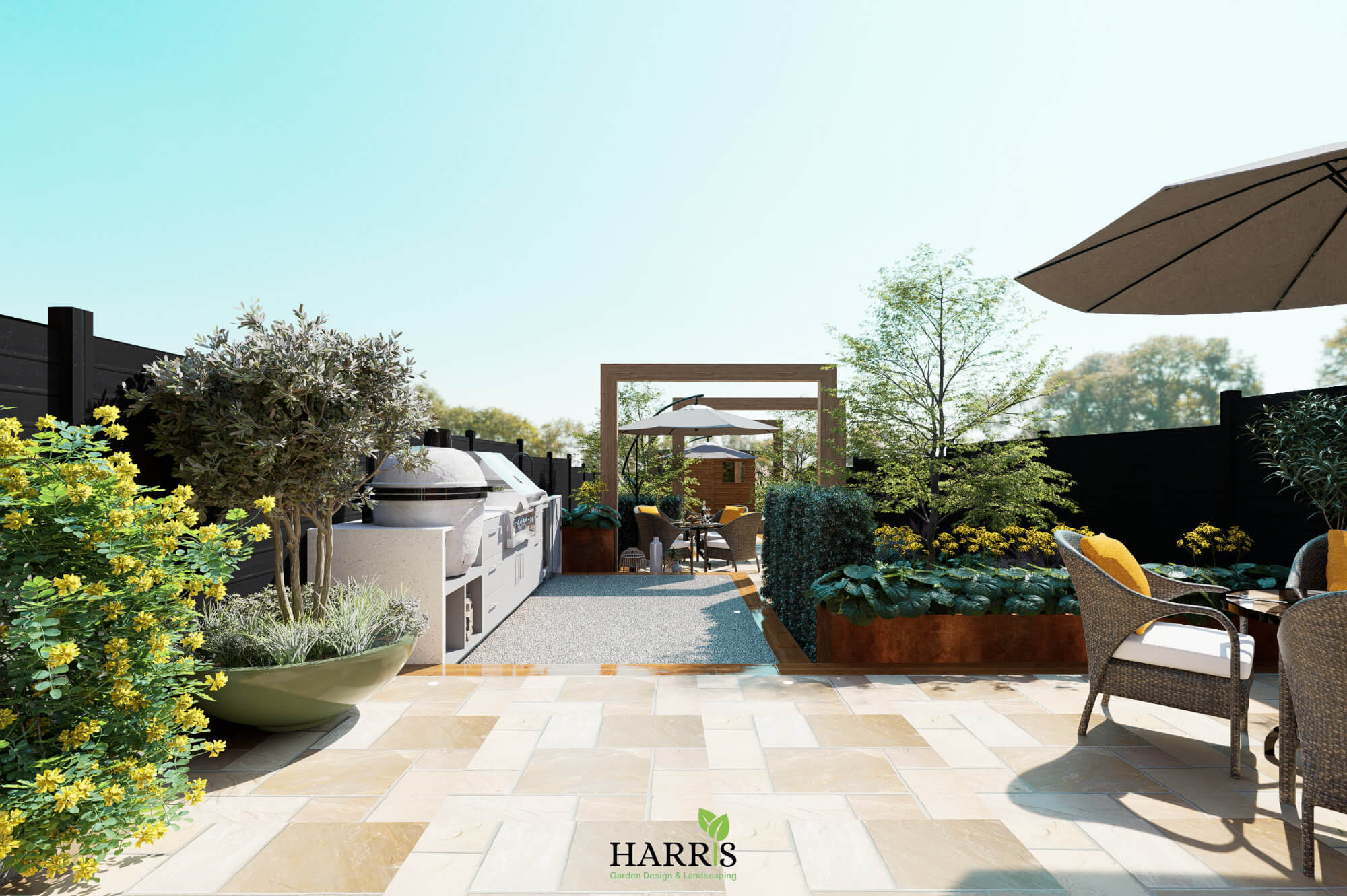
The lines between inside and outside living has never been more blurred, and garden design in 2026 fully embraces this shift. Homeowners in Bolton are looking to create outdoor spaces that function as true extensions of the home. Instead of a simple patio or lawn, the modern garden incorporates intentional, well-designed zones that feel like fully furnished “rooms.”

Covered seating areas, outdoor kitchens, fire pits, lighting schemes, and durable flooring materials create spaces that can be used day and night, all year long. This approach not only enhances lifestyle and comfort but dramatically increases the functional square footage of the property — a major advantage for growing families and those who love to entertain.

3. Low-Maintenance, High-Impact Garden Layouts

The Reality: People Want Beauty Without the Work

As one of the strongest themes in garden design in 2026, low-maintenance layouts are being purposefully designed to deliver visual impact with minimal effort. This involves selecting durable hardscaping materials, simplifying planting palettes, reducing lawn areas, and integrating mulching or weed-suppressing borders. Bolton residents with busy schedules value spaces that are not just attractive but effortless — giving them more time to enjoy their garden instead of maintaining it.

4. Multi-Functional Spaces for Modern Lifestyles

Homeowners are intentionally designing outdoor spaces that adapt to their changing lifestyles, creating seamless transitions between relaxation, work, fitness, and entertainment. A garden may now feature a dedicated work-from-home studio, a yoga or meditation deck positioned to catch the morning sun, and a sheltered hosting area designed for evenings with friends.

For families, flexible spaces that double as play zones or movie-night areas are becoming increasingly popular. The overarching theme is versatility — a garden should evolve alongside the people who use it, supporting numerous activities without feeling cluttered or disjointed.

5. Sustainable Materials and Eco-Friendly Solutions

Sustainability has moved beyond trend status — it’s now a core expectation in modern garden design. Bolton residents are actively seeking eco-friendly solutions that reduce environmental impact while increasing longevity and performance. The outcome is a space that not only looks impressive but actively contributes to healthier ecosystems and long-term environmental responsibility.

6. The Rise of Modern Minimalism in Garden Design

Clean lines, uncluttered spaces, and simple palettes are replacing fussy, high-maintenance layouts.

  • Strong geometry in pathways and patios. Think rectangles, straight-edged borders, and grid-style paving layouts.
  • Limited material palette like:
    • Grey, cream, or anthracite porcelain
    • Composite decking in slate tones
    • Clean rendered walls or cladding

7. Smart Gardens: Technology Goes Outdoors

As smart-home technology becomes more mainstream, Bolton homeowners are extending it beyond the four walls of the house and into the garden. A smart garden leverages automation to enhance convenience, reduce maintenance and increase enjoyment.

Popular upgrades include app-controlled lighting systems, automated irrigation, robotic lawnmowers, outdoor speakers, and WiFi boosters to support work or entertainment spaces.

These technologies allow homeowners to create highly functional gardens that adapt to their routines — whether that means setting irrigation schedules, lighting up the garden at dusk, or streaming music during gatherings.

8. Naturalistic Design and Rewilding Trends

A distinct shift is taking place as homeowners embrace a more natural, relaxed approach to landscaping. Rather than striving for immaculate lawns and rigid symmetry, many people are adopting controlled wilderness — a style that mimics natural habitats while remaining intentional in its layout. Features such as meadows, gravel paths, mixed-height planting, and wildlife ponds help create a sense of immersion in nature.

This movement supports biodiversity, attracts pollinators, and provides a calming retreat from the demands of modern life. Naturalistic gardens also tend to require less intervention, making them ideal for homeowners who want a beautiful space without intensive upkeep.

9. The Comeback of Water Features

Water features are experiencing a strong resurgence in garden design in 2026, thanks to their ability to elevate a space both aesthetically and functionally. Whether it’s a sleek blade waterfall, a reflective pool, a wildlife-friendly pond, or a self-contained fountain, water elements add movement, texture, and tranquillity to the garden.

For many Bolton homeowners, water features also serve practical purposes: masking traffic noise, boosting biodiversity, or acting as a central focal point in modern layouts. Their versatility allows them to complement both contemporary and traditional gardens, making them one of the most desirable additions of the year.

The Future of Garden Design in Bolton

Garden design in 2026 is practical, sustainable, stylish, and forward-thinking. Bolton homeowners are prioritising low maintenance, multifunctionality, climate-smart planting, and sustainable materials — transforming their outdoor spaces into extensions of their lifestyle.

If you’re planning a garden redesign in 2026, the best decision you can make is to work with a specialist who understands Bolton’s climate, soil conditions, and evolving design trends. A professionally designed garden doesn’t just look better — it performs better, lasts longer, and adds real value to your home.

Ready to Transform Your Garden? Get in touch today. Let’s turn your vision into a space you’ll enjoy for years to come.


Garden Design vs ‘Just Landscaping’ in Bolton

Garden Design vs ‘Just Landscaping’ in Bolton – What’s the Real Difference?

When you start researching ideas for your garden, you’ll see lots of companies in Bolton offering landscaping – and a smaller number talking about garden design. On the surface they sound similar, but there’s a big difference in how your project is planned, built and ultimately how it feels to live in.

At Harris Garden Design, we offer a design-led garden design and build service across Bolton and the surrounding areas. Here’s what that really means, and how it compares to “just landscaping”.


What is “just landscaping”?

Many landscapers are brilliant at installing:

  • Patios and paths

  • Lawns and artificial grass

  • Sleeper beds and retaining walls

  • Fencing, pergolas and features

You might show them a few photos from Pinterest, they give a price, and then they install those items as requested. There’s usually no full plan, no scaled drawings and no real consideration of how the space will work as a whole.

You’ll end up with individual elements that look nice – but they may not make the best use of the space, and things like views, privacy, orientation, sun, drainage and planting can be an afterthought.


What is professional garden design?

Garden design starts long before a spade goes into the ground.

A designer will:

  • Talk to you about how you live – kids, pets, entertaining, quiet time, future plans

  • Survey the garden, levels, sun, shade and existing features

  • Create a scaled design that shows layout, zones and flow

  • Choose materials, colours and planting that suit your home and style

  • Plan lighting, access, screening and focal points

The result is a cohesive, thought-through garden that works in every season – not just a patio and some turf.


Practical benefits for a Bolton garden design

In and around Bolton, we see:

  • Sloping plots and tricky levels

  • New-build gardens that are compact but overlooked

  • Older properties where drainage and access can be a challenge

A proper garden design tackles these issues on paper first, so when our landscaping team starts on site, everyone knows exactly what’s happening and why. That usually means:

  • Better use of every square metre

  • Fewer changes and surprises during the build

  • A garden that feels bigger, calmer and easier to live with


So which do you actually need?

If you just want a small patio replacing like-for-like, a basic landscaping job might be enough.

But if you’re investing in a full garden transformation in Bolton or the surrounding areas, professional garden design will:

  • Maximise your budget

  • Avoid costly mistakes

  • Create a space that genuinely fits your family and lifestyle

At Harris Garden Design, we combine bespoke garden design with expert landscaping to deliver complete, design-led gardens from first sketch to final plant.

If you’re ready to move beyond “just landscaping” and want a garden that’s properly designed around you, we’d love to chat.

Why a Professional Garden Design Package in Bolton Saves You Money Long Term

Most homeowners in Bolton start their outdoor projects with one goal: create a garden that looks beautiful and works for everyday life. But here’s the truth many people discover far too late — without a professional garden design plan, even the best ideas can become expensive mistakes.

From misjudged layouts to incorrect materials, drainage issues, and redesigning areas twice, cutting corners at the planning stage almost always costs more in the long run. A professionally created garden design package isn’t just about choosing plants and drawing nice layouts. It’s a strategic blueprint that saves you money, prevents costly errors, and ensures every part of your garden functions exactly as you need it to — now and for years to come.

At Harris Garden & Landscaping, we’ve transformed countless Bolton gardens that started with frustration, wasted money, or the wrong DIY decisions. This is why we believe every homeowner should begin with a professional design phase. Below, we break down exactly how a garden design package saves you money long term — with real examples, expert insights, and practical guidance.

The Hidden Costs of “Just Figuring It Out as You Go”

Many garden projects in Bolton begin with enthusiasm — a patio here, a lawn there, maybe some raised beds later. But designing a garden without a plan is like building a house without architectural drawings. Here’s what typically goes wrong: work needs redoing when initial choices don’t function properly, materials are purchased that aren’t suitable for the conditions or purpose, space is used poorly with awkward corners and wasted areas, and drainage planning is overlooked until water pooling becomes a serious problem.

How a Professional Garden Design Package Saves You Money

A garden design package from Harris Garden & Landscaping is a complete planning and budgeting tool that ensures you only pay once, for the right work, done the right way.

1. Accurate Planning and Budgeting

Professional garden design starts with understanding your needs, your site, and your budget. Every detail is calculated in advance — from material quantities to lighting positions — so there are no surprises later. Our clients in Bolton often say the biggest benefit of design is clarity. You know exactly what you’re paying for, when it’s happening, and how it fits into your long-term vision.

2. Correct Material Selection for Bolton Conditions

A designer familiar with local conditions knows what works. Frost-proof porcelain paving, non-slip surfaces, and locally suited planting are all chosen to reduce replacements and long-term maintenance. For example, porcelain paving resists frost, algae, and stains better than sandstone, while composite decking stays non-slip during wet Bolton winters. Native shrubs and perennials thrive in heavy soil with less upkeep. These details save thousands in future repairs and replacements.

3. Preventing Drainage Failures

Drainage issues are one of the most expensive problems homeowners face — yet they’re also one of the easiest to prevent with proper design. A professional design includes correct levels and gradients, soakaways or French drains, permeable paving or gravel beds, and retaining walls with proper weep holes. Good drainage protects your patios, lawns, and foundations from costly water damage.

4. Efficient Use of Space

Design isn’t just about aesthetics; it’s about flow. A skilled designer knows how to position patios, paths, lawns, and planting beds to make every inch functional. For example, placing a patio where it gets afternoon sun maximises usability, while designing paths with clear sightlines prevents wasted corners. Locating storage out of view keeps the space clean and organised. These small design choices save money on unnecessary features and improve day-to-day usability.

5. Phased Installation that Fits Your Budget

A professional design gives you a roadmap for building your garden in stages without redoing earlier work. You can complete high-priority features now — like patios or retaining walls — and add planting, lighting, or decking later. Because the plan covers every detail, you’ll never waste money re-laying turf, moving pipework, or adjusting levels again.

6. Long-Term Value and Reduced Maintenance

A well-designed garden continues saving money for years through reduced upkeep. Properly positioned plants shade patios, prevent weeds, and protect soil. Smart material selection reduces cleaning and repair needs. More importantly, a cohesive layout adds property value — a designed garden in Bolton can increase sale prices by 5–10%, often paying back the design cost many times over.

Why Choose Harris Garden & Landscaping for Your Garden Design

With years of experience transforming outdoor spaces across Bolton and Greater Manchester, our team understands how to balance design vision with practical construction. Our garden design packages include full consultation and site survey, 2D and 3D concept visuals, material and planting specifications, drainage and level planning, phased project roadmap, and detailed cost breakdown. We don’t just design for today — we design for how you’ll live tomorrow.

FAQs — Garden Design in Bolton

1. How much does a professional garden design package cost? Design packages typically start from a few hundred pounds, depending on garden size and complexity. The cost is quickly offset by preventing expensive errors later.

2. Do I need a design if I already know what I want? Even if you have a vision, a professional designer ensures it’s practical, properly scaled, and achievable within your budget.

3. Will a design delay my project? No — it actually speeds it up. With a clear plan, builders and landscapers work more efficiently, reducing downtime and wasted materials.

4. Can I build my garden in stages? Yes. A design package provides a phasing plan so you can complete your garden in logical steps without redoing work.

5. How do I get started? Book a consultation with Harris Garden & Landscaping. We’ll discuss your ideas, survey your space, and create a tailored design proposal.

A Smart Investment That Pays You Back

A professional garden design package isn’t an unnecessary expense — it’s the smartest investment you can make in your outdoor space. It saves money by preventing costly mistakes, ensuring long-term durability, and creating a garden that enhances your home’s value and your quality of life. Whether you’re upgrading a small town garden or transforming a large Bolton plot, design is where smart spending begins.

Ready to Save Money with a Smarter Garden Plan?

Let’s create a garden designed for how you live — beautiful, functional, and built to last. Book your professional garden design consultation with Harris Garden & Landscaping today.